IT outsourcing lets you add skilled people without the cost and delay of hiring in-house - through staff augmentation, IT staff augmentation or a dedicated development team. The partner you choose matters more than the model.
Growth changes what a business needs from its team.
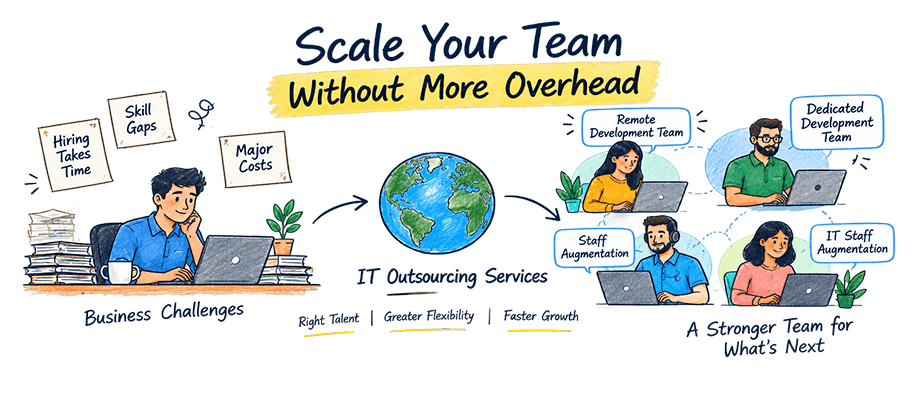
At the beginning, hiring a few people and managing everything internally can work well. But as projects grow, priorities shift and new opportunities appear, the same approach can start creating friction. Hiring takes time. Skill gaps slow delivery. Teams become stretched. And adding permanent headcount for every new requirement is not always the smartest move.
This is where IT Outsourcing Services can create practical flexibility.
The goal is not simply to send work outside the company. Done well, outsourcing gives a business access to the right skills, additional capacity and a reliable way to scale without carrying unnecessary overhead.
Outsourcing Should Solve a Real Business Problem
Outsourcing works best when it starts with a clear question: What is slowing the business down?
Maybe the internal team has more work than it can handle. Maybe a project needs skills that are difficult to hire locally. Maybe the business needs to move faster without committing to several permanent positions.
The answer should determine the outsourcing model.
A good partner does not begin by selling a team. It begins by understanding the work, existing processes, timelines, technical requirements and level of control the business wants to retain.
That difference matters. The right team should fit into the way your business already operates, not force you to rebuild your processes around an external vendor.
Three Ways to Extend Your Team
Not every business needs the same level of support. That is why flexible engagement models are important.
-
Staff Augmentation Services are useful when your existing team can lead the work but needs additional capacity or specific expertise - across engineering, design, marketing, content, data or support.
You might need a content writer for a product launch, a designer for a new interface, or a data analyst for a reporting push. Instead of creating a permanent role, you add the capability you need for as long as you need it.
The advantage is control. Your existing team continues to manage priorities, workflows and day-to-day execution while the additional talent works as part of the team.
-
IT Staff Augmentation narrows that to technology roles specifically, for businesses that need additional engineering expertise without going through a lengthy hiring process.
You can add developers, QA engineers, DevOps specialists, or other technical professionals based on what the project requires. This works especially well when your technology roadmap is moving faster than your internal hiring.
But adding people is only part of the equation. They need to understand your tools, communication style, expectations and product context. When that alignment is right, the external team becomes a natural extension of your business.
-
Dedicated Development Team can provide the consistency needed for long-term work for businesses with ongoing product or technology requirements.
Instead of bringing in different people for individual requirements, you build a focused team around your roadmap. The team stays involved, develops deeper knowledge of your product, and works with a clearer understanding of your technical and business goals.
This model can work particularly well for software products, internal platforms, continuous development and projects where requirements will evolve over time.
The benefit is continuity. As the team understands your product, users, technology, and processes more deeply, collaboration becomes smoother and decisions become faster.
Why Businesses Choose Outsourcing
The strongest reason to outsource is rarely cost alone.
It is usually flexible.
A business can access talent without waiting months to build an internal hiring pipeline. It can increase capacity during busy periods and reduce it when priorities change. It can bring in specialized skills without creating permanent positions for every capability.
There is also a question of focus.
Your core team should be spending its energy on the work that moves the business forward. If experienced people are constantly pulled into tasks outside their main responsibilities, growth can become slower even when the company is busy.
A well-structured external team can absorb some of that pressure while allowing internal leaders to stay focused on product, customers, strategy and growth.
Why India Is Part of the Conversation
For global businesses, India has become an important destination for technology talent. The attraction is not simply access to a larger talent pool. Businesses also look for specialized skills, flexible engagement models and the ability to build teams without the overhead associated with local hiring.
That is why companies researching IT Outsourcing Companies in India should look beyond the size of a vendor's team.
Ask how talent is selected. How does communication work? Who manages quality? How quickly can the team scale? What happens when someone is not the right fit? How are intellectual property and data handled?
The answers tell you much more than a list of technologies ever will.
The Partner Matters More Than the Model
Outsourcing does not automatically create better results.
The wrong partner can introduce communication gaps, inconsistent quality, unclear ownership and more management work than it removes.
The right partner should make things simpler.
That means vetted people, transparent communication, clear responsibilities, reliable quality checks and enough overlap with your working hours to keep collaboration moving. It also means giving businesses the flexibility to scale their team as their requirements change.
At Anantya TechLabs, the focus is on making external talent feel like a genuine extension of the business. The team is vetted before being introduced, dedicated rather than shared across clients and supported through the engagement.
The objective is straightforward: give businesses the capability they need without creating another layer of complexity.
When Should You Consider Outsourcing?
Outsourcing may be worth considering when:
- Your team has more work than its current capacity.
- A project requires skills you do not have internally.
- Hiring locally is taking too long.
- You need temporary expertise for a specific phase.
- Your technology roadmap is growing faster than your team.
- You want to scale without immediately increasing permanent overhead.
It is not about replacing your team. In many cases, it is about giving your team enough support to do its best work.
Conclusion
Outsourcing should not feel like handing your business to someone else.
It should feel like gaining the right people at the right time, with the flexibility to grow without unnecessary complexity.
When the model, people and partnership are aligned, outsourcing becomes more than a way to fill skill gaps. It becomes a practical part of building a business that can move faster, stay focused and scale with confidence.
The real question is not whether you should outsource. It is whether your current team structure is ready for where your business is going next.
FAQs
What is IT outsourcing?
IT outsourcing means working with an external technology partner to access people, skills, or delivery capabilities that support your internal business. The arrangement can range from individual specialists to complete dedicated teams.
Is staff augmentation the same as outsourcing?
Staff augmentation is one form of outsourcing. The main difference is the level of integration and control. With staff augmentation, external professionals typically work within the client's existing team and processes.
When is a dedicated team better than individual resources?
A dedicated team is generally more suitable when development is ongoing and the business needs consistent capacity over a longer period. Individual resources can be better when the requirement is limited to a specific skill or temporary capacity gap.
How do I choose an outsourcing partner?
Look at talent quality, communication, transparency, security, scalability, ownership and how closely the partner can integrate with your existing team. The cheapest option is not always the lowest-cost option if poor delivery creates additional work.