
Your business needs custom software when off-the-shelf tools stop fitting - your website is not converting, your workflow is unique or your team relies on spreadsheets and workarounds. If an existing tool or a simple integration solves the problem, use that instead.
Your business needs custom software when the tools you already use stop fitting the way you work - and your team spends more time working around the software than with it.
At first, a ready-made tool usually feels like the right choice. It is quick to set up, familiar to your team and handles the basics.
Then the business grows.
More customers. More employees. More data. More processes.
Suddenly, people are moving information between platforms, creating reports manually, maintaining spreadsheets, or finding workarounds because the software does not quite fit.
That is when a different question becomes important: Does your business need custom software?
The answer is not always yes. But there are some clear situations where building technology around the way your business actually works can make more sense than adding another generic tool.
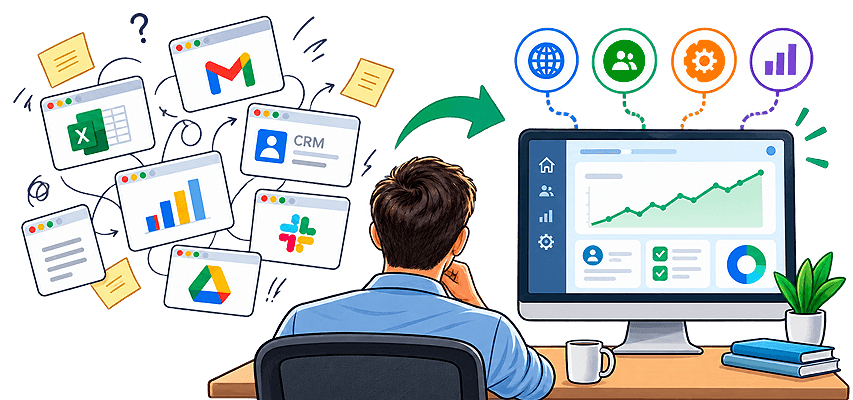
When Off-the-Shelf Software Stops Fitting
Off-the-shelf software is useful for many businesses. There is no reason to build something custom when an existing platform already solves the problem well.
The challenge starts when your business begins adapting its processes to the software.
A specific approval flow does not fit. Two systems do not share data. Reporting requires manual exports. Your team maintains spreadsheets alongside the main platform.
Each workaround may seem small.
Together, they create friction that gets more expensive as the business grows.
That is often the point where it is worth looking at the technology underneath the operation.
1. Conversion Infrastructure: When Your Website Needs to Work Harder
Your website is more than the place where people learn about your business.
For many companies, it is the first step in a customer journey. A visitor may discover a service, compare options, submit an enquiry and expect someone to follow up.
But what happens behind the form?
If leads are not reaching the CRM properly, lead sources are difficult to identify, analytics are disconnected, or there is no clear journey from visitor to enquiry, the website may look good without actually supporting the business.
This is where custom software development can play a role in building conversion infrastructure.
A conversion-focused web platform can be designed around how your buyers make decisions. It can include clear user journeys, intentional calls to action, CRM and analytics integrations and performance measurement based on leads and conversion rates rather than traffic alone.
The goal is simple: make the website part of the business system, not an isolated digital brochure.
2. Business Process Platforms: When Your Workflow Is Unique
Every business has processes, but not every business operates in the same way.
You might have a particular approval structure, specialized reporting requirements, unique data relationships, or a workflow that changes depending on the customer, department, or transaction.
Generic SaaS platforms are built to serve broad requirements. Eventually, your business may reach a point where those predefined workflows become restrictive.
Instead of improving the process, your team starts working around the software.
This is where custom application development can become useful.
A business process platform can be designed around your actual workflows and data models. It can automate repetitive steps, reduce approval bottlenecks, connect information across systems and provide the flexibility to evolve as the business changes.
The important idea is not “custom is always better.”
It is that your software should support the way your business operates when generic tools can no longer accommodate it.
3. Custom Internal Tools: When Your Team Is the Workaround
Some of the most expensive technology problems happen behind the scenes.
A spreadsheet becomes essential for operations. An employee maintains a separate tracker because the main system does not show the right information. Managers wait for manually prepared reports. Teams develop their own methods for handling approvals, inventory, clients, or internal requests.
These workarounds are easy to overlook because the business still functions.
But the cost compounds every day.
Custom software solutions such as internal dashboards, admin panels, management systems, approval tools and team-specific applications can be built around the tasks employees actually perform.
The objective is not to give your team another application to learn.
It is to remove unnecessary steps and make important information easier to access, manage and act on.
How the Three Areas Work Together
These three areas can also form one connected technology system.
Your website captures demand. Your business platform processes information and workflows. Internal tools help your team manage operations.
Behind all of this, data and integrations keep information moving between the systems that need it.
That is where business process automation becomes valuable. Instead of automating isolated tasks, businesses can connect automation to the workflows that genuinely consume time.
The same principle applies to business process management software: technology should make processes easier to manage, measure and improve.
Custom Software or Another Tool?
Before building anything, ask a practical question:
What is the current problem costing the business?
Consider the hours spent on manual reporting, duplicate data entry, disconnected systems, approval delays, errors and workarounds.
If an existing product solves the problem effectively, keep using it.
If a simple integration can connect two systems, integrate them.
If automation can remove repetitive work, automate it.
But when the problem is important, recurring, specific to your business and difficult to solve with existing software, custom technology may be the more sensible long-term investment.
Is Your Software Still Working for Your Business?
Your software should make work easier, not create more work. If your team is constantly using spreadsheets, moving data between tools, or working around system limitations, it may be time to rethink your technology. Sometimes you need better integration or automation.
Sometimes you need technology built around the way your business actually works.
The goal is not to build more software. It is to make your business work better.
FAQs
What are examples of custom software?
Examples include conversion-focused websites, business platforms, customer portals, internal dashboards, admin panels, reporting systems, approval workflows and applications built around specialized business processes.
What is the difference between generic and custom software?
Generic software is designed for broad business needs. Custom software is designed around a specific organization's workflows, data, users and operational requirements.
How much does custom software cost?
There is no universal cost. It depends on functionality, integrations, security, users, scalability and the complexity of the business problem being solved.
Is custom software only for large businesses?
No. A small or growing business may benefit when a critical process is unique, repetitive, or difficult to manage with existing tools.
When should a business consider custom software?
Consider it when software limitations are creating significant manual work, disconnected systems, operational bottlenecks, reporting problems, or difficulties scaling.


